Right to Manage Reforms: Changes to the Right to Manage in force as of 3rd March 2025


Today sees the coming into force of several provisions of the Leasehold and Freehold Reform Act 2024 (‘LFRA 2024’) relating to the Right to Manage. This note explains some more detail about this and what these changes mean for leaseholders and freeholders.
 
What is the right to manage?
 
Leaseholders have a collective right to take over the management of their building under a no-fault right known as the Right to Manage (‘RTM’). RTM is a statutory no-fault right introduced by the Commonhold and Leasehold Reform Act 2002 and provides a useful alternative to buying the freehold as there is no capital outlay (other than costs).

In order to effect this change at least half of the qualifying leaseholders in the building must serve the relevant notices and participate in the process.

What are the changes?


The reforms make changes to the basis of qualification, the ability of the landlord to recover costs in a standard case and to the articles of association of the Right to Manage Company.
 
Changes to qualifying buildings
 
Until now buildings would only qualify for RTM of not more than 25% of the property is used for non-residential purposes. Now, buildings with up to 50% of the property in non-residential (e.g. commercial use) will qualify for these rights.
 
This means that many more buildings will fall within the scope of the Right to Manage. The Act also proposes that the freeholder will not be able to recover its costs of dealing with the RTM claim from the leaseholders.
 
Landlord’s Costs – now generally not recoverable
 
Up until now the landlord has been able to recover the costs of dealing with the RTM claim from the RTM company at the end of the process. Now, the standard provision has been amended so that in a non-contentious claim the landlord cannot recover any of its costs from the RTM company or the participating leaseholders.
 
The law relating to service charges is being amended too so that non-litigation costs cannot be recovered via the service charge (where in the past this may have been possible in some cases where section 19 of the Landlord & Tenant Act 1985 would permit this).
 
There are some qualifications to this. Where a court or tribunal orders that a party should pay costs then an RTM company can be asked to pay the landlord’s costs. The First Tier Tribunal of the Property Chamber (FTT) will have the power to award costs where a claim has been made and withdrawn (or become deemed withdrawn), or where the RTM company has acted unreasonably. Members of the RTM company can be held jointly and severally liable for these costs. These are likely to be circumstances where there is a dispute about the validity of the notice or there is a challenge made to the actions of the RTM company.
 
However, the general effect will be that as costs will not be payable in an uncontested case that bringing an RTM claim has become less costly from the leaseholders’ perspective.
 
Changes to the RTM Company Articles
 
The RTM Company is a ‘creature of statute’ – its articles are prescribed by the Commonhold and Leasehold Reform Act 2002 (‘the 2002 Act’).
 
After the handover takes place, the landlord is entitled to a vote for each interest that it has in the building. This could include multiple interests and a concern was raised that the freeholder or a landlord could end up with control of the company or a very significant vote now that the qualification criteria have been amended so that a building with 50% non-residential will qualify.
 
To prevent this happening a set of regulations (the RTM Company (Model Articles) (England) (Amendment) Regulations 2025) have amended the standard RTM company articles so that now the votes exercisable by landlords cannot exceed one third of the votes exercisable by the qualifying tenants.
 
What else is changing?

 
There are also provisions preventing first instance applications to the High Court. This is to prevent attempts to circumvent the costs provisions. In addition, where a party seeks to enforce obligations arising under the RTM these applications must now be made to the tribunal rather than to the court in the first instance.
 
In Conclusion

 
These changes are part of the first raft of changes made under LAFRA and are as promised by Matthew Pennycook in his 21st November 2024 statement.
 
For leaseholders wanting to exercise the Right to Manage this is good news as the absence of landlord’s costs and the new qualification threshold will probably result in more claims. For managers and landlords, the need to obtain effective advice remains but with the sting that this is at their own cost when a claim is exercised. Will this lead to improved management service levels? Possibly, if the threat of ‘losing the account’ is there. It also might make claims more drawn out if landlords fail to respond.
 
Whilst these are not the most significant changes envisaged by LAFRA they are certainly ‘game changers’ in the field of Right to Manage.
 
Mark Chick
3rd March 2025

 

Leasehold Reform News: The abolition of the ‘two-year rule’ with effect from 31st January 2025 – makes it easier to claim an extended lease or purchase the freehold to a leasehold house

The Government has taken the first steps towards implementing the Leasehold and Freehold Reform Act 2024 with the abolition of the contentious two-year rule. The change is in force as of 31 January 2025 and is intended to make it easier and faster for leaseholders to extend their lease, or to buy the freehold to their leasehold house, from the first day of ownership.

As a result, leaseholders will no longer have to wait two years after the point of purchasing their property before exercising their right to extend their lease or buy their freehold.

As I predicted earlier in the year, this change is a ‘quick win’ for government and is one of the easiest provisions of the Leasehold and Freehold Reform Act 2024 (‘LAFRA’) to have enacted.

There are several other provisions that have NOT yet been ‘switched on’ – notably the 990 years lease extension and the valuation changes.

Progress towards the valuation changes is likely to be slow, particularly given that yesterday the High Court gave permission for the six claimants in the Human Rights Act challenges to the legislation permission to bring their cases for judicial review of the legislation. The substantive hearing of this case is likely to take place towards the end of July 2025, around the same time that the Government plans to start consulting on the applicable ‘rates’ to be used in the revised leasehold reform valuation mechanism that LAFRA seeks to bring in.

I expect this to cause further delay to the implementation of the valuation reforms.

The two-year rule

Removing the two-year rule does make it easier for leaseholders to bring a claim to extend their lease under the 1993 Act, or for those owning a qualifying leasehold house to bring a claim to buy the freehold under the 1967 Act.

The two-year rule has always sat awkwardly with the position in relation to the 1993 Act for collective enfranchisement for blocks of flats where since the previous reforms in the Commonhold and Leasehold Reform Act 2002 there has been no ‘two year’ ownership requirement.

There are some technical points to be observed as well. The qualifying tenant must be the owner of the property to bring the claim and the registered owner at that. That means that during the so called ‘registration gap’ after a purchase that the person owning the title (even if they have sold) may need to give the claim notice and the benefit of this will need to be assigned. That issue will fall away assuming that registration goes through quickly but as we know from current experience the Land Registry can be subject to lengthy delays.

The bigger picture

In terms of the broader picture of leasehold reform, this is a step in the right direction, but leaseholders have been waiting a considerable amount of time for further changes to be forthcoming. Although the Leasehold and Freehold Reform Act 2024 received royal assent on 24 May 2024, much of the secondary legislation within the Act remains to be implemented and many of the much-needed reforms contained in the Act remain some way off.

There is also the promise of a new piece of legislation – a draft Commonhold and Leasehold Reform Bill. There is no sight of this yet but this is likely to be a large piece of legislation and one that will not hit the statute books or come into force quickly. We await a draft Bill later this year, along with the promised White Paper on Commonhold.

The year 2025 promises to be a busy year for leasehold reform, with a number of consultations promised.

However, for those purchasing a leasehold property, the abolition of the two-year rule at least provides them with the flexibility and choice to about when to seek a lease extension, provided that the lease is acceptable for lending purposes (otherwise they will still need to seek to put an extension in place before completing).

In the meantime, for those with a short lease the time to act may well be now, although, as ever specific facts and circumstances will determine what the right course of action will be.

Mark Chick

31.1.2025

Leasehold reform news – Human Rights Challenges 

So we have the outcome of the permission hearing in the High Court today – the six claimants have been granted permission to apply for Judicial Review of various provisions in LAFRA 2024, including marriage value, the implied ground rent cap in the new valuation model, cost shifting and the issues known to affect intermediate landlords. 

The substantive hearing will not be until the end of July.  That will chime in nicely with the proposed consultation on setting rates that is promised for the later part of this year. 

It seems to me that none of these provisions can be brought into force without the government knowing where it is likely to be on these issues. This (together with the prospect of any appeals etc) may make the proposed ‘switch on’ of the valuation aspects of LAFRA some way off. 

There is no doubt much to consider when advising clients. Does this make the time line look even more like 12-18 months from a date later on this year? 

Would that mean 2027? Or maybe even later? Dependant perhaps also on the proposed Commonhold and Leasehold Reform Bill? Lots to consider.

Mark Chick

30th January 2025

The abolition of the ‘two year rule,’ What does this mean for leaseholders?

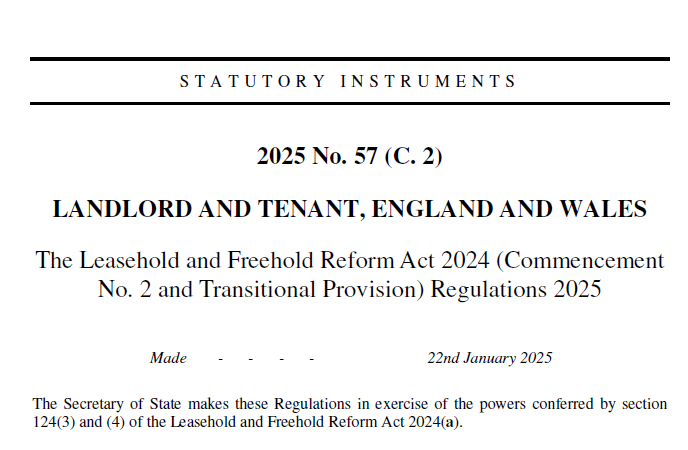
The Leasehold and Freehold Reform Act 2024 (Commencement No.2 and Transitional Provision) Regulations 2025

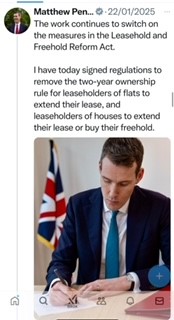
On 22nd January 2025,  Matthew Pennycook confirmed that he had signed the snappily entitled ‘Leasehold and Freehold Reform Act 2024 (Commencement No. 2 and Transitional Provision) Regulations 2025.’

https://www.legislation.gov.uk/uksi/2025/57/contents/made

These bring into law the provisions of Section 27 of the Leasehold and Freehold Reform Act 2024 (‘LAFRA’), which removes the requirement for a qualifying tenant to have owned their flat for more than two years prior to bringing a claim to an extended lease.

The provisions of Section 27 come into effect from the 31st January and therefore claims made on or after this date can simply be made by the qualifying tenant.

What does this mean in practice?

It’s good news for those buying a property with a short lease – no need for a two-year wait – but, as always, things are never that straightforward. The valuation regime has not yet changed and therefore the question of whether to go ahead will require consideration, particularly if the lease extension premium is likely to be significant and might be reduced as and when the changes to ‘marriage value’ (which applies only where the lease is under 80 years) come into effect.

Good news for those who have a short lease that they are trying to sell

The fact that the buyer won’t have to wait to extend a lease will, in theory, mean that there will be no need to have the benefit of the claim assigned to the buyer, although as mentioned above, without the valuation reforms there is no other immediate benefit. The commencement does mean that the buyer can go ahead and then choose when to extend the lease.

However, this won’t avoid the issue for leases that need to be extended for mortgage reasons. In other words, if the lease needs to be ‘long’ for lending purposes then the lease extension will still have to be put in place before completion.

Legal Title – is there an issue?

Who can make the claim? The qualifying tenant 

Section 43 of the 1993 Act is still in force. The claim cannot exist separately from the lease. And therefore, if the previous owner does start the claim (for whatever reason) the claim does still need to be assigned.

The reason for this is that when you buy a property, the title register is not immediately updated. Delays at the land registry, which for a standard non-urgent transaction can take up to two years, are well documented and leave something of a ‘Registration Gap’.

In the short term, even after completion, the seller (who is still the registered owner of the title, even though they no longer own the property) is a ‘constructive trustee’ for the buyer, during the so-called ‘registration gap.’

In terms of who has title to bring the claim, this is likely to be the registered owner; and that person is the ‘tenant’ under the terms of the lease.

All well and good if the registration can be expedited (there are grounds for doing this, one of which would be hardship) but evidence must be shown to the land registry. For instance, a lease that was very short and where a delay might cause prejudice/ increasing cost on a daily basis might be good grounds. However, is the land registry ready for an influx of new applications? I am not so sure about that. So, we may still see assignments of the benefits of claims and notices for some time to come.

What does this mean in practice?

Essentially this is good news for leaseholders as there is no two-year wait to initiate a claim, but they will need to sure that they have appropriate evidence of their qualification, and this may cause some issues in practice.

Whilst we await the reforms, the question of whether to serve notice or not remains a live issue and can only be decided based on the leaseholder’s individual situation. One thing does remain clear, if you are buying a property where the lease needs extending, getting the right advice about how to approach this will still be key.

Mark Chick

28th January 2025